By ANDREW MCINTOSH AND KINIA ADAMCZYK, QMI AGENCY
Oil-rich Saudi Arabia has quietly secured a better visa deal for the rapidly growing number of Saudis entering Quebec and Canada to study or work, the QMI Agency has learned.
From 1984 to 2002, Saudi nationals could enter and leave any part of Canada without a visa.
But after the 9/11 terrorist attacks in the United States, visa requirements were imposed on Saudis following security concerns about stolen and fraudulent Saudi passports and the number of 9/11 attackers that came from the Kingdom of Saudi Arabia.
Thursday, July 22, 2010

Thursday, May 27, 2010
Monday, May 10, 2010
Sunday, May 09, 2010
Development: keep or kick? Africa's time is NOW

It is time for Africans to assume full control over their economic and political destiny. Africans should grasp the many means and opportunities available to them for improving the quality of life," argues Dambisa Moyo (left) an international economist who writes on the macroeconomy and global affairs. She is the author of critically acclaimed New York Times Bestseller Dead Aid: Why Aid is Not Working and How there is a Better Way for Africa, which details the inefficacy of development aid for poor countries.
Saturday, May 08, 2010
No more poverty by 2015?

We are dot-connectors. The watchdogs of power structures.
We have the responsibility of being fair and accurate; to be accountable to our audience and to trust our public's intelligence. We shall inform and inspire further research.
We are journalists. 20 of us, 10 from Africa and 10 from Eastern Europe, will team up to report about Millennium Development Goals in Africa this summer.
(Top: Costa, a reporter from Zambia, and Aleksandra, a former classmate of mine from the College of Europe.)
Empowerment. Support. Control. Politics. Manipulation. Values. Pity ... = development aid
Friday, May 07, 2010
East4South training starts today in Brussels


Development Awareness from the Roots
Gathering EU and sub-Saharan journalists
to report on international development issues
Varsovie mon amour

Warsaw, my love. I had left her last June (2009) without really saying goodbye. Oh, how vibrant she is at the moment! I had missed the sound of the trams echoing in her streets, her pretty faces, her language. Her languages, for she is a very cosmopolitan city now.
Portrait video Concours Jeune Correspondant 2010 (Radio-Canada)
Voici les quatre finalistes:
 Nom: Kinia Adamczyk
Lieu de résidence: Montréal
Âge: 25 ans
Kinia termine un bac en Communication et en Journalisme à l’Université Concordia pendant lequel elle a notamment remporté un prix Forces avenir pour des reportages effectués au Guatemala et en ex-Yougoslavie.
Elle a aussi suivi un programme en journalisme international aux Pays-Bas et au Danemark et poursuivi des études de 4e cycle à Varsovie en plus de fonder la revue électronique cosmopolitanreview.com
Parlant 6 langues, elle a déjà visité une vingtaine de pays. La gouvernance de l’économie mondiale, la place des femmes dans les sphères du pouvoir et les relations du Canada avec l’Union européenne sont au nombre des enjeux qui l’intéressent particulièrement.
Thursday, April 22, 2010
Jeune correspondante avec Radio-Canada?

Me voilà à mon endroit favori, la Dominion Tavern sur Metcalfe, avec une productrice de Radio-Canada. Elle réalise un portrait des quatre finalistes du concours Jeune Correspondant (dont je fais partie).
Wednesday, April 14, 2010
From the Top
13 Apr 2010 Prime Minister Stephen Harper today announced that he will attend the State Funeral of President Lech Kaczynski and First Lady Maria Kaczynska on Sunday, April 18, in Krakow, Poland.
"This Sunday, the people of Poland will lay to rest a true patriot and a staunch defender of democracy and human rights," said Prime Minister Harper. "On behalf of all Canadians, I will express our country's respect for a strong and trusted ally and stand alongside the Polish people in their grief."
President Kaczynski, the First Lady and numerous political, military and civil society leaders were tragically killed on Saturday in a plane crash en route to an event commemorating the 70th anniversary of the Katyn Massacre.
Apr 13 2010 On Saturday evening, the President will travel to Krakow, Poland to attend the State Funeral of President Lech Kaczynski and First Lady Maria Kaczynska on Sunday, April 18th. The President will travel to Krakow to express the depth of our condolences to an important and trusted ally, and our support for the Polish people, on behalf of the American people.
Tuesday, April 13, 2010
CR commemorates
Poland in the Rockies alumni, CR contributors and their friends continue sending words of grief, reflection and remembrance our way:
PitR alumnus and film maker Eric Bednarski Captures Grief in Warsaw (photoreportage)

Canadian PM Stephen Harper Announces National Day of Mourning for President of Poland - 15 Apr 2010
OTTAWA - Prime Minister Stephen Harper announced on 12 April 2010 that Canada will mark a National Day of Mourning on Thursday, April 15, following the death of Lech Kaczynski, President of Poland, who died in a plane crash on Saturday along with Polish political, military and civil society leaders.
OTTAWA - Prime Minister Stephen Harper announced on 12 April 2010 that Canada will mark a National Day of Mourning on Thursday, April 15, following the death of Lech Kaczynski, President of Poland, who died in a plane crash on Saturday along with Polish political, military and civil society leaders.
Wording the Unspeakable - Dispatch from Ottawa
13 Apr 2010 By Dominic Roszak The unspeakably tragic death of the Polish President and numerous Polish leaders shocked the world. Some have called it tragically ironic, occurring near that 'cursed' place of Katyn. While it was and remains difficult for me to comprehend the scale of this disaster, I find myself hit with a deep sense of sorrow when reading about the vibrant lives that each of the victims had led. These were people whom Poles knew very well as being devoted to the service of their country; coming from all sides of the political spectrum and a wide range of positions of responsibility. Most of them were also proud parents. I cannot help but keep imagining in my mind the moment that the plane went down...the last thoughts in their minds and the despair felt by their families when they learned of the crash. It is a haunting thought.
13 Apr 2010 By Dominic Roszak The unspeakably tragic death of the Polish President and numerous Polish leaders shocked the world. Some have called it tragically ironic, occurring near that 'cursed' place of Katyn. While it was and remains difficult for me to comprehend the scale of this disaster, I find myself hit with a deep sense of sorrow when reading about the vibrant lives that each of the victims had led. These were people whom Poles knew very well as being devoted to the service of their country; coming from all sides of the political spectrum and a wide range of positions of responsibility. Most of them were also proud parents. I cannot help but keep imagining in my mind the moment that the plane went down...the last thoughts in their minds and the despair felt by their families when they learned of the crash. It is a haunting thought.
13 Apr 2010 By Roger Cohen My first thought, hearing of the Polish tragedy, was that history's gyre can be of an unbearable cruelty, decapitating Poland's elite twice in the same cursed place, Katyn.
13 Apr 2010 By Allen Paul The tragic crash that wiped out nearly half the leadership of the Polish government Saturday is a stark reminder that death stalks always in ways no man can see.
Late last Friday I declined an offer to fly with those whose lives were so suddenly and unexpectedly lost. The invitation came at the end of an hour-long meeting with a close friend, Andrzej Przewoznik, the high-ranking official in charge of on-the-ground arrangements for the visit of President Lech Kaczynski and his entourage to the cemetery in Katyn Forest near where the crash occurred.
13 Apr 2010 By Vince Chesney These past few days have been numbing. Although we in the Anthracite Coal Region may only be the fingertip on the hand that is Poland, we still flinch whenever the motherland is harmed. Even those that have no Polish identity can certainly appreciate Poland's loss by imagining a comparative catastrophe in America.
It is my hope that by screening Wajda's Katyń that the students here can appreciate Poland as a partner in liberty who's history intertwines with its young fellow Eagle: America. Boże, coś Polskę!
12 Apr 2010 By Ania Barycka April 10 will forever be a memory etched in my mind. It began with a shock, my roommate waking me up, his fists pounding on my door and his voice saying something tragic was on the news. I got up, unlocked the door, and found him shaking. "A terrible, terrible tragedy," he began. I was barely awake; his voice trembled as he told me about the deaths of the Polish President, his wife, and almost a hundred other members of the Polish government in a tragic airplane crash. I just stood there, half asleep, wondering when I would awake from this nightmare.
Monday, April 12, 2010
Poland Grieves
CNN - Why Poland's Grief is Doubled
11 Apr 2010 By Alex Stororzynski The tragic death of President Lech Kaczynski and Poland's political and military elite among the trees of the Katyn Forest is surreal, given that in those same woods, thousands of Polish prisoners of war were murdered by Joseph Stalin's secret police.
Newsweek - What's Next for Poland
11 Apr 2010 By Alex Stororzynski The tragic death of President Lech Kaczynski and Poland's political and military elite among the trees of the Katyn Forest is surreal, given that in those same woods, thousands of Polish prisoners of war were murdered by Joseph Stalin's secret police.
Newsweek - What's Next for Poland
10 Apr 2010 By Patrycja Romanowska On April 10, the courtyard of the presidential palace in Warsaw was aglow as grief stricken people lit candles encased in coloured glass and prayed for the souls of those who had once lived there. In Krakow, church bells tolled heavily and even the sky wept, sending down thick sheets of rain to drench the hundreds of people gathering to mourn at the Wawel Cathedral. The evening mass began with Cardinal Stanislaw Dziwisz somberly listing the names of the 93 people who had died in a plane crash in Smolensk, Russia only hours before.
BBC News - Looking beyond Poland's 'unprecedented disaster'
10 Apr 2010 ... Krzysztof Bobinski consider the immediate and longer-term effects of the 70th anniversary of the massacre in a wood outside Smolensk. ...
Remembering the Katyn Forest Massacre
7 Apr 2010 By Wanda Urbanska After weeks of delay, the Russians issued my friend Allen Paul a visa yesterday. He had been invited by Prime Minister Donald Tusk to be a part of the Polish delegation to the ceremony at Katyn, to mark the 70th anniversary of the Soviet massacre of more than 20,000 of Poland’s military officers and reservists, its best and brightest, in 1940.
7 Apr 2010 By Justine Jablonska A historic meeting scheduled for Wednesday between top leaders of Russia and Poland is expected to provide new details about Russia's mass execution of 22,000 Polish officers in the Katyn forest in 1940 and may open the way toward improved relations between the two countries.
The mass slaying of the Polish prisoners of war by the Soviet secret police is one of the darker and less known chapters of World War II, said Kyle Parker, a Russian expert and policy adviser to the Commission on Security and Cooperation in Europe, an independent U.S. agency that helps formulate American policy for the Organization for Security and Cooperation in Europe.
Sunday, April 11, 2010
Gloomy Saturday

+ Krystyna Bochenek
+ gen. Tadeusz Buk
+ Grzegorz Dolniak
+ Grażyna Gęsicka
+ P. Gosiewski
+ Mariusz Handzlik
+ I. Jaruga-Nowacka
+ R. Kaczorowski
+ S. Karpiniuk
+ Andrzej Karweta
+ J. Kochanowski
+ Janusz Kurtyka
+ Tomasz Merta
+ A. Natalli-Świat
+ Piotr Nurowski
+ Maciej Płażyński
+ Ks. Tadeusz Płoski
+ A. Przewoźnik
+ Krzysztof Putra
+ Sławomir Skrzypek
+ Władysław Stasiak
+ A. Szczygło
+ Jerzy Szmajdziński
+ Szymanek-Deresz
+ A. Walentynowicz
+ Z. Wassermann
+ Wiesław Woda
+ Paweł Wypych
+ Janusz Zakrzeński
+ inne ofiary / other victims
+ gen. Tadeusz Buk
+ Grzegorz Dolniak
+ Grażyna Gęsicka
+ P. Gosiewski
+ Mariusz Handzlik
+ I. Jaruga-Nowacka
+ R. Kaczorowski
+ S. Karpiniuk
+ Andrzej Karweta
+ J. Kochanowski
+ Janusz Kurtyka
+ Tomasz Merta
+ A. Natalli-Świat
+ Piotr Nurowski
+ Maciej Płażyński
+ Ks. Tadeusz Płoski
+ A. Przewoźnik
+ Krzysztof Putra
+ Sławomir Skrzypek
+ Władysław Stasiak
+ A. Szczygło
+ Jerzy Szmajdziński
+ Szymanek-Deresz
+ A. Walentynowicz
+ Z. Wassermann
+ Wiesław Woda
+ Paweł Wypych
+ Janusz Zakrzeński
+ inne ofiary / other victims
BY CR CONTRIBUTORS: Krzysztof Bobiński, Wanda Urbanska, Justine Jablonska
BBC News - Looking beyond Poland's 'unprecedented disaster'
10 Apr 2010 ... Krzysztof Bobinski consider the immediate and longer-term effects of the 70th anniversary of the massacre in a wood outside Smolensk. ...
Remembering the Katyn Forest Massacre
7 Apr 2010 By Wanda Urbanska After weeks of delay, the Russians issued my friend Allen Paul a visa yesterday. He had been invited by Prime Minister Donald Tusk to be a part of the Polish delegation to the ceremony at Katyn, to mark the 70th anniversary of the Soviet massacre of more than 20,000 of Poland’s military officers and reservists, its best and brightest, in 1940.
7 Apr 2010 By Justine Jablonska A historic meeting scheduled for Wednesday between top leaders of Russia and Poland is expected to provide new details about Russia's mass execution of 22,000 Polish officers in the Katyn forest in 1940 and may open the way toward improved relations between the two countries.
The mass slaying of the Polish prisoners of war by the Soviet secret police is one of the darker and less known chapters of World War II, said Kyle Parker, a Russian expert and policy adviser to the Commission on Security and Cooperation in Europe, an independent U.S. agency that helps formulate American policy for the Organization for Security and Cooperation in Europe.
Wednesday, March 31, 2010
Reminiscing Guatemala - 2006 dispatches for the Center for International Studies and Development
The sound of corn
 San Juan la Laguna wakes up to the sound of corn mills. I love the saying here, ‘sin maís no hay país’, which means, ‘without corn there is no country’. Even if you’re in the mountains, you still hear the corn mills from the peak.
Women and girls line up in the morning with their bowls of the yellow grain to get it processed into a paste that resembles butter. Then, it’s tortilla-time. All the food here is served with tortillas.
I ate in a comedor today- the cook still hadn’t arrived at my eco-hotel by 8:30 and my stomach was growling. For eight quetzals (about $1.50), I got beans, eggs, rice, a bunch of tortillas and a coffee with too much sugar. What’s great is that eight hours later, I’m feeling fine. I think my digestive system is finally going local.
Took-took, pickups and colourful buses
 Guatemala boasts a colourful palette of means of transportation. The most common is the chicken bus (so baptized by tourists because… well, the description that follows should depict it fairly enough.) The chicken bus is an old diesel-fuelled Canadian or American school bus painted in bright colours and decorated with flashing lights. The driver has a helper than hangs on to the side of the bus, shouting the destination as the bus honks a few times. The point is to squeeze in as many people as possible, so sometimes a human has to transform into a monkey and literally climb over the other passengers’ heads in order to get out. Animals have been known to travel in these buses, including chickens in bottomless cages sitting above the passengers. When nature calls… If you haven’t been on a chicken bus, you haven’t been in Guatemala.
In the more mountainous regions, one can opt for a colectivo, which is a pick-up truck that goes from town to town. It usually costs Q1.50, a few cents. It can actually be quite fun to ride on the pick-up. If you’re lucky, they’ll cover you with plastic when it rains. If not, at least you’ll have your ride and a shower too.
Took-tooks are three-wheeled taxis. Apparently, five years ago, they didn’t exist in Guatemala. The concept was imported recently from Asia. My first took-took experience was a bit ‘sketchy’. I was in Antigua, it was already dark and rainy. I had to take a took-took to the house I was staying at, but the driver had a hard time finding the street, which was actually a dirt road. Of course, my heart started beating a bit faster as we went back and forth without finding the place. But eventually we found it. Another proof that more than 90% of the things we worry about don’t happen…
Saving the earth
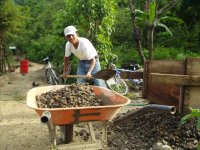 San Juan la Laguna was severely affected by hurricane Stan. This community’s main mode of subsistence is agriculture, so when heavy rain washed away its lands, its people were rather disempowered. Nevertheless, with the help of Fundación Solar, tremendous progress has been made here since the hurricane. An earth-saving program was implemented with incentives for farmers to clean up the boulders choking their lands, reforestation projects are under way with the help of tree gardens that breed the plants that will fill the lands when they are cleaned up, and vegetable gardens were created so people don’t have to depend on exterior help to eat.
The city is pretty clean, because the Fundación equipped it with trash cans that didn’t exist before, and because people are getting sensitized to the importance of hygiene. Traditional arts, crafts and medicine are being valued through touristic circuits which allow the visitors to tour the local artists’ associations and workshops. There are also two eco-hotels offering rooms within a very natural ambience, offering organic coffee, foods, shampoo and toilet paper… One of them has an advanced recycling program which included composting.
I see a lot of potential within this little town bordered by the magical Atitlán lake…
Faces of San Juan
I think my few days of photography lessons have paid off, and I’m much happier with the pictures that I’ve been taking since then.
 San Juan la Laguna wakes up to the sound of corn mills. I love the saying here, ‘sin maís no hay país’, which means, ‘without corn there is no country’. Even if you’re in the mountains, you still hear the corn mills from the peak.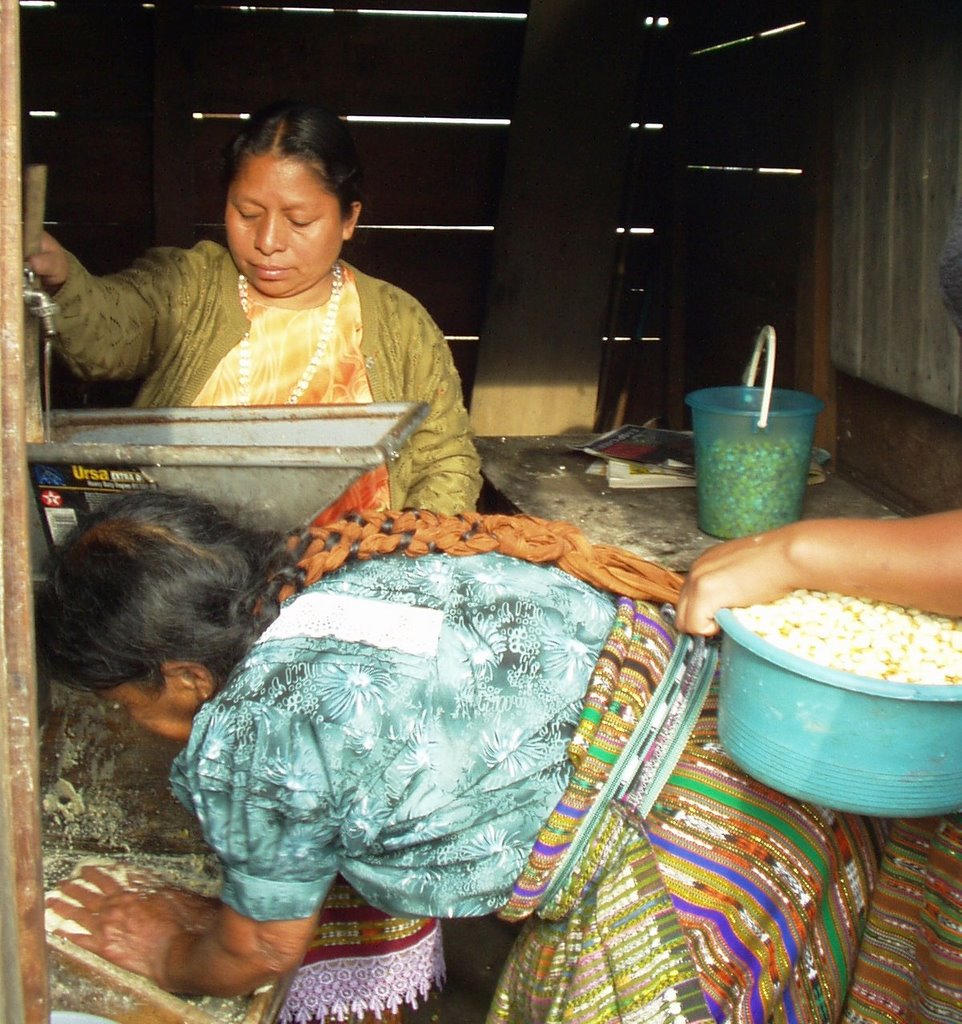
Women and girls line up in the morning with their bowls of the yellow grain to get it processed into a paste that resembles butter. Then, it’s tortilla-time. All the food here is served with tortillas.
I ate in a comedor today- the cook still hadn’t arrived at my eco-hotel by 8:30 and my stomach was growling. For eight quetzals (about $1.50), I got beans, eggs, rice, a bunch of tortillas and a coffee with too much sugar. What’s great is that eight hours later, I’m feeling fine. I think my digestive system is finally going local.
Took-took, pickups and colourful buses
 Guatemala boasts a colourful palette of means of transportation. The most common is the chicken bus (so baptized by tourists because… well, the description that follows should depict it fairly enough.) The chicken bus is an old diesel-fuelled Canadian or American school bus painted in bright colours and decorated with flashing lights. The driver has a helper than hangs on to the side of the bus, shouting the destination as the bus honks a few times. The point is to squeeze in as many people as possible, so sometimes a human has to transform into a monkey and literally climb over the other passengers’ heads in order to get out. Animals have been known to travel in these buses, including chickens in bottomless cages sitting above the passengers. When nature calls… If you haven’t been on a chicken bus, you haven’t been in Guatemala.
In the more mountainous regions, one can opt for a colectivo, which is a pick-up truck that goes from town to town. It usually costs Q1.50, a few cents. It can actually be quite fun to ride on the pick-up. If you’re lucky, they’ll cover you with plastic when it rains. If not, at least you’ll have your ride and a shower too.
Took-tooks are three-wheeled taxis. Apparently, five years ago, they didn’t exist in Guatemala. The concept was imported recently from Asia. My first took-took experience was a bit ‘sketchy’. I was in Antigua, it was already dark and rainy. I had to take a took-took to the house I was staying at, but the driver had a hard time finding the street, which was actually a dirt road. Of course, my heart started beating a bit faster as we went back and forth without finding the place. But eventually we found it. Another proof that more than 90% of the things we worry about don’t happen…
Saving the earth
 San Juan la Laguna was severely affected by hurricane Stan. This community’s main mode of subsistence is agriculture, so when heavy rain washed away its lands, its people were rather disempowered. Nevertheless, with the help of Fundación Solar, tremendous progress has been made here since the hurricane. An earth-saving program was implemented with incentives for farmers to clean up the boulders choking their lands, reforestation projects are under way with the help of tree gardens that breed the plants that will fill the lands when they are cleaned up, and vegetable gardens were created so people don’t have to depend on exterior help to eat.
The city is pretty clean, because the Fundación equipped it with trash cans that didn’t exist before, and because people are getting sensitized to the importance of hygiene. Traditional arts, crafts and medicine are being valued through touristic circuits which allow the visitors to tour the local artists’ associations and workshops. There are also two eco-hotels offering rooms within a very natural ambience, offering organic coffee, foods, shampoo and toilet paper… One of them has an advanced recycling program which included composting.
I see a lot of potential within this little town bordered by the magical Atitlán lake…
Faces of San Juan
I think my few days of photography lessons have paid off, and I’m much happier with the pictures that I’ve been taking since then.
CIDA and NATO Efforts in the Balkans

"I think it's important for the Canadian public to realize that we and the peaceful Western world, with our good governance and our affluence, have a responsibility to step up to the plate to assist countries who are struggling," said Maj. Greg Frank, who has been serving since last March on Canada's last military mission to Bosnia and Herzegovina, Operation Bronze.
Recovering a Stolen Childhood - Justine Jablonska
by Justine Jablonska, for the cosmopolitanreview.com
Wesley Adamczyk survived deportation to Siberia and exile to chronicle that journey in “When God Looked the Other Way,” published by the University of Chicago Press in 2004. His father, Jan Adamczyk, was one of tens of thousands of Polish officers killed in the Katyn massacre.
Over the years, Adamczyk, a tireless activist on behalf of Polish history, has collected memoirs and mementos of the Polish children in exile in Iran, India and Africa, including children's autograph books. A few are shown below; their descriptions are located at the bottom of the article.
1940
It is spring 1940 and the world is more than a year deep into a war that will last five more. Wesley Adamczyk is 7. He has sandy blond hair and large blue eyes, and loves listening to his father tell stories about knights and ancient battles. Some days, Wesley likes playing hide-and-seek with his sister.
 But not on this day, because he is on a train eastbound out of his Polish homeland. He tried packing his toys and books, but the soldiers said no. And so he huddles with his mother, sister and brother in a crowded train wagon with no seats or sanitation or food, hurtling toward Kazakhstan.
When they arrive, they'll spend the first day of more than 700 in a Soviet forced labor camp. For weeks and months on end, they will almost freeze and nearly die from starvation. They are only one Polish family out of countless others being deported to Siberia as the war rages on. During the worst, coldest, hungriest winter days, Wesley dreams of home. And of food. He also dreams of his father (all the children do), and their reunion. They haven't heard from him, or of him, for a long time. But it's wartime, and they're deep in Siberia. Thinking about their father sustains them.
Captain Jan Adamczyk, Wesley's father, is 47.
Or, was 47.
Tuesday, March 30, 2010
I'm a Woman, Not a Headscarf: Debate in Canada, reflections from Turkey
 The Gazette: MONTREAL – Proposed legislation that bans the niqab from government offices, the education system and health care reflects a broad consensus in Quebec that equality of the sexes is paramount, rights experts said yesterday.
But any further step to purge religious symbols from the public sphere would intrude on individual rights, said constitutional lawyer Julius Grey. “We shouldn’t follow France into secular radicalism,” he said. “I believe that is too dogmatic, and I do not think we should make secularism a religion.” Read more in The Gazette.
The niqab... a piece of garment that speaks a thousand words, as it veils the face of a woman, revealing the eyes only through a slit.
Under Bill 94, tabled March 24 in the National Assembly in Canada, "all public sector employees will be required to have their faces uncovered, as will any citizen using government services, for example, someone paying her car registration or applying for a medicare card. The ban on such face coverings as the niqab or burqa also applies to the entire education sector, from daycare centres to universities, as well as hospitals, public clinics and social services," The Gazette reported on March 26, 2010.
This debate sparked thoughts and memories from a sojourn in Turkey, where over 90% of the population is Muslim, and where it is prohibited to wear the headscarf in universities and schools.
"La moitié des Québécois n'en veulent pas"

En revanche, 45,6% pensent le contraire, révèle l’enquête en ligne de Léger Marketing, dévoilée en exclusivité à l’Agence QMI. From canoe.com
Thursday, March 25, 2010
In love with music

Tuesday, March 23, 2010
Istanbul: Lust, Attraction and Attachment

Whether she is modestly covered, sometimes barely looking you in the eye; or exposing her countless delights, İstanbul rarely fails to entice her visitors. Her name was Constantinople when Byzantium controlled her. She kept it even after the Ottomans took over in 1453, until the Turkish Republic's father, Mustafa Kemal Atatürk, reformed the Turkish language in the 1920s, adopting the Latin alphabet, and giving the beautiful city a new name. İstanbul is a shortened version of the Greek phrase ΕΙΣ ΤΗΝ ΠΟΛΙΝ (EIS TIN POLIN), meaning "to the city", since Constantinople was the biggest, wealthiest and most populated metropolis of the times. (Top: A bar with a view- old, squeaky apartments buildings often hide breath-taking rooftop sights. KA) MORE
Subscribe to:
Posts (Atom)